


In the aftermath of tragedy, competition for limited resources often intensifies, creating tension between organizations in need. Following the devastating antisemitic attack in Boulder on June 1, 2025, local Jewish organizations faced the familiar challenge of securing adequate crisis funding. The attack had shaken the community to its core, leaving physical damage, emotional trauma and urgent financial needs in its wake.
But rather than engaging in the typical scramble for resources, these organizations chose a different path — one of unprecedented collaboration that would ultimately redefine what’s possible when communities face their darkest hours.
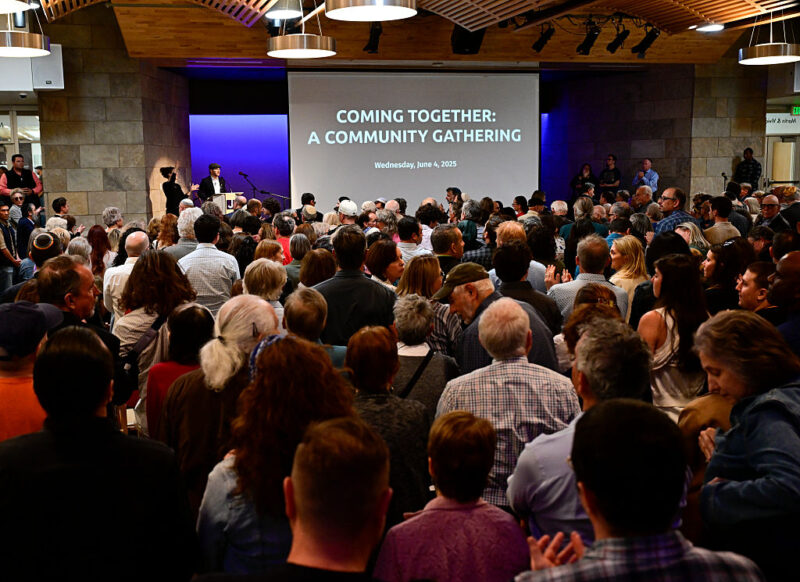
Andy Cross/MediaNews Group/The Denver Post via Getty Images
A community vigil at the Boulder Jewish Community Center in Boulder, Colo., on Wednesday, June 4, 2025, after a man set fire to people using a makeshift flamethrower and Molotov cocktails on June 1 during a peaceful demonstration to raise awareness for hostages being held by Hamas in Gaza.
When JEWISHcolorado raised approximately $210,000 in emergency funds, the Boulder JCC facilitated something remarkable: a community-wide conversation where organizational leaders set aside individual interests to determine the most effective use of these critical resources. In conference rooms where competitive grant applications might typically be drafted, leaders instead gathered to ask a fundamentally different question: not “How much can we get?” but “How can we best serve our community together?”
What emerged was nothing short of revolutionary in philanthropic circles. The group unanimously prioritized victims’ needs first, directing substantial support to the local Run For Their Lives Movement, which had been advocating tirelessly for hostages and working to address the human toll of the crisis, while also being the direct target of the attack. This decision set the tone for everything that followed—a clear signal that individual organizational needs would take a back seat to collective community welfare.
When the needs exceeded available funds, in an extraordinary display of communal responsibility, every organization voluntarily reduced its respective funding request to ensure more equitable distribution. This wasn’t mandated by funders or imposed by external pressure. It was a choice, one which reflected a profound understanding that their fates were intertwined — that the strength of each organization depended on the health of the entire ecosystem.
The feeling in the community was one of appreciation and pride in a shared commitment to do what was best for everyone. Rachel Amaru, lead organizer for the local Run for Their Lives group, reflected on the process: “I’m grateful for having had the ability to work with the broader Jewish community and am appreciative of the work Jco did to make these funds possible.”
The larger institutions, Boulder JCC and Jewish Family Service, accepted 55% of their revised budgets, acknowledging their capacity to secure additional funding elsewhere through established donor relationships and broader networks. Smaller organizations received 70% of their revised requests, recognizing their limited fundraising capabilities and the disproportionate impact that emergency funding would have on their operations. This tiered approach ensured that eleven local Jewish organizations received meaningful support based on collective recommendations rather than competitive positioning.
“This collective approach meaningfully impacted each leader, each organization and our entire community,” noted Jonathan Lev, Boulder JCC executive director. “The pre-existing relationships and trust among these organizations enabled them to respond with remarkable speed and unity. Years of collaboration, shared programming and mutual support had built the foundation that made this moment possible.”
JEWISHcolorado president and CEO Renée Rockford observed that this collaborative model allowed for unprecedented efficiency that meant “our allocations committee was able to review and process grants within days so that emergency dollars were in the hands of those who needed them most in record time,” she said. In a sector where grant processes typically stretch across weeks or months, this rapid response demonstrated what becomes possible when trust replaces competition.
In choosing transparency over competition and collective welfare over institutional gain, Boulder’s Jewish community provided a compelling model for crisis response that extends far beyond emergency funding. They demonstrated that scarcity doesn’t have to breed competition, that crisis can catalyze collaboration and that the way we distribute resources matters as much as the resources themselves.
This approach raises important questions for the philanthropic sector: What if emergency funding became an opportunity to strengthen community ties rather than strain them? What if the distribution process itself became part of the healing by engaging grant participants in the decision making process? What if we measured success not just by dollars distributed but by relationships strengthened and trust deepened?
The Boulder example suggests that when communities face their darkest moments, collaborative funding models not only distribute resources more effectively, but they also help rebuild the social fabric that tragedy threatens to tear apart. It’s a powerful lesson that deserves consideration far beyond Colorado, offering a blueprint for how communities everywhere might respond when crisis strikes and resources are scarce, but the need for unity has never been greater.
Heidi Dormody is the senior director of development at the Boulder JCC.
Shari Edelstein is an American-Israeli Jewish professional, grant writer and member of the Boulder community.